

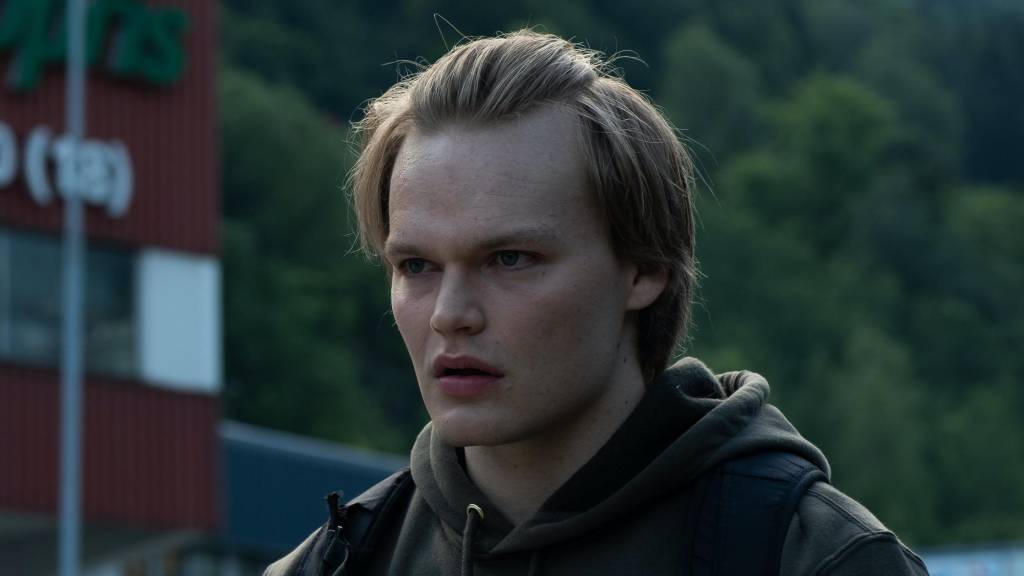
I’ve recently finished the second season of Ragnarök (2020-present), a Norwegian drama series on Netflix. As a student being away from home, with an incapacitated Netflix account, I’ve found it quite challenging to keep up with the sheer amount of shows. However, if there is one that I do make sure to watch…this is it.
Shot in what has become synonymous as the Scandinavian drama, grey tinted lens, Ragnarök comes to us viewers as a quasi-Highschool teenage drama surrounding the lives of the stoic 18-year-old Magnus and his self-proclaimed ‘outsider’ brother, Lauritz. In the first season -which I will briefly and poorly describe to pique interest rather than retell the entire season; Magnus, Lauritz and their mother, Turid, move to the remote location of Edda whilst reeling from the death of their father. It is here their world begins to go awry, transcending from the rigidity of life and into the fictive. For this we can blame Jutul Industries, the powerful energy plant that comes to threaten the family’s peaceful yet fragile existence.
The events of Ragnarök slowly begin to weave its way into the fabric of the town. Introducing us to characters of Thor, Loki, the Seeress and the subsequent conflict between the Gods and the Jotunn (giants) that starts to unravel during a local fight for ecological change. Ragnarök gently nudges the viewer towards the realisation of its own intelligence, perhaps nodding towards the increasing acknowledgment of ecocritical thought.
The show provides a visual construction of the Poetic Edda, specifically Voluspa or ‘The Seeress’ prophecy’ in a modern retelling. For example, the mythical destroyers of the Earth do not come crashing down from the other-worlds encased in cloaks of fire and rage, but instead drive through Edda’s narrow streets in an sleek estate. Or something like Jutul Industries, which takes on the role of synecdoche for human-instigated ecological damage. In the most dramatic terms possible, the apocryphal destruction of mortal and mythological life. These interactions between the text and contemporary cultures and between nature and the anthropological highlight how these texts become increasingly more important. That even these pillars of economic and social significance hold serious environmental consequences that cannot and should not be ignored.
The rise of popularity of Norse mythological dogma has come to dominate a large range of media we see today. The Marvel Franchise with the likes of Loki (2021) the television show on Disney+ or the impending addition to the Thor franchise Thor: Love and Thunder (2022). This prevalence comes in tandem to become a greater space for thought and this is strangely exciting. If you are like me and are not the biggest fan of the Highschool drama trope, I would not say that this is particularly off putting. Instead, I see it as something that is more accessible for younger people than myself to be introduced to environmentalism and the wonders of Medieval Norse Mythology.
Furthermore, in the greater context of Greta Thunberg and her ‘Skolstrjk for Klimatet’ movement, which launched her into the eco-political stratosphere, protests by Extinction Rebellion (in the UK) and the UN’s recent COP26 conference which congregated many of the world leaders a shared space; we can truly acknowledge the varying facets in which environmental concern is coming to the forefront of discussion.
Whilst in reality, the challenges we face are not manifestations caused from the intervention of dark, mythologised figures, but are something incredibly real and daunting. This does not mean that we cannot find hope in the dramatic. Instead, we can access, through adaptation, how texts formed in a time arguably more connected to the nuances of nature -from a land defined by its fire and ice- provide us with the opportunity to mend the environmental disconnect many of us experience in everyday life.
Ultimately, this is a show that is entertaining, unique but at times stoic in its deliverance. Yet as a whole I can safely say it is one of the series that I’ve enjoyed this year. It gave me an opportunity to reflect and consider the role of literary adaptation and alternate forms of media as means to elaborate and participate in environmental discourse. Whilst the first season has really been in the forefront of my review, I feel obligated to add that season 2 of Ragnarök was also very good and enjoyable. In fact, it felt as if the cast had really began to meld with their characters, and I can only express my other thoughts by saying that the show felt more comfortable within its rhythms. Furthermore, it has been interesting to observe how the show continues to expand upon the horizons of the storybook town of Edda; but I will refrain from saying too much!
 Spotlight Magazine
Leave a comment