
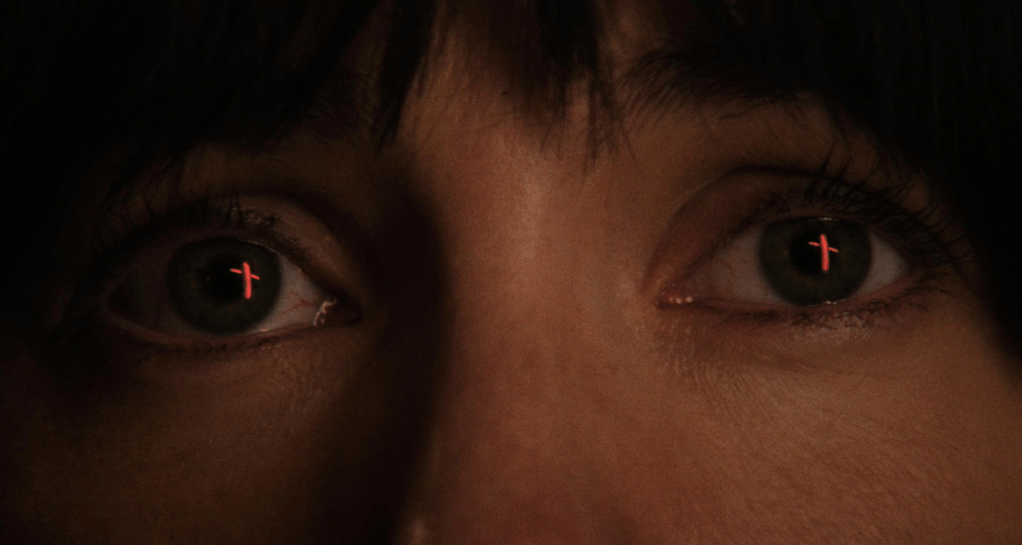
Every August, the Locarno Film Festival lights up my hometown for two weeks, and as a local, attending has always been a must for me. This year, I watched about seven films, most of which were screened in the festival’s iconic open-air venue, Piazza Grande. With a capacity of around 8,000, it is known as the world’s largest open-air cinema. Surprisingly, though, the film I want to talk about wasn’t shown on the grand screen. Instead, Fréwaka (Clarke, 2024) premiered in a much more intimate venue—La Sala—which, amusingly, is inside the gym of my old high school.
I walked in with no expectations, as it was the film’s debut and little had been revealed about it. Based on its brief synopsis (“Shoo is sent to a remote village to care for an agoraphobic woman who fears sinister entities, the Na Sídhe. As they develop a connection, Shoo becomes entangled in the old woman’s paranoia, rituals, and superstitions, eventually confronting the horrors of her past”), I expected a tale of familial legacy and generational conflict. But I was pleasantly surprised to find that director Aislinn Clarke had taken a much more intriguing route, framing the story through the lens of folk horror. Since our last print issue was horror-themed and the new print issue will be centred around myth and magic, I thought Fréwaka would be the perfect film to discuss.
Alfred Hitchcock, often called the ‘Master of Suspense’, famously stated, “There is no terror in the bang, only in the anticipation of it.” Aislinn Clarke masterfully applies this principle in Fréwaka, inducing fear not by revealing the object of terror, but by removing it from the screen. This technique is exemplified in the film’s portrayal of the Na Sídhe—the Irish fairy folk—who are rarely, if ever, seen, despite being a constant topic of discussion.
Forget the stereotypical possessed dolls, eerie clowns, or satanic creatures. While such horrors can be effective in their own right, Clarke takes the fear a step further by leveraging the mythical invisibility of the Na Sídhe, transforming it into an on-screen invisibility that is profoundly unsettling. Their unseen presence is further amplified by the enigmatic land they inhabit—an equally invisible realm that feels hauntingly close, yet just out of reach. Rather than being a distant, mythical world, it is depicted as an unseen dimension lurking beneath the surface of the human experience—disturbingly close, yet impossible to define.
By the end of the film, the audience is left grappling with the lingering question: What are the Na Sídhe, really? And long after watching Fréwaka, I still find myself pondering whether these elusive fairies are perhaps something far more insidious—an embodiment of our darkest instincts, the vengeful and malevolent side of the human psyche that we fear to confront.
Overall, I highly recommend watching this. It is a unique experience, and one that I will treasure and carry with me for a long time.
Part 2: Interview
Through Spotlight Magazine, I was able to contact director Aislinn Clarke and arrange an interview with her. With this, I hope to offer new insights into Fréwaka and spark our readers’ interest in watching it. Additionally, I aim to provide insight into the behind-the-scenes process and the art of filmmaking—something that has always fascinated me. So, let’s begin!

JF: Hello Aislinn, it is a pleasure to have you here with us today, and congratulations on your release of Fréwaka! I often find that choosing a title is one of the hardest parts of writing/art. Should it summarize the content, tie everything together, add a twist, or be intentionally elusive? There are many ways to approach this, and I’d love to know how you arrived at your title and what it means to you.
AC: ‘Freamacha’ was the title of the film from quite early on. In Irish, it is a deeply evocative word to me: it suggests a particular type of gnarled tree root, so complex and compacted and entangled that it is very difficult to break apart and uproot. It requires great strength and brutality to pull the thing from the earth. This is very much like the deep-rooted psychic trauma in the Irish psyche and the idea suggests the intergenerational trauma that passes through families back to an ancient source. The English word ‘roots’ doesn’t have the same gravitas and isn’t as gothic and dark. Fréwaka is an anglicisation of the original Irish, as the sales agents loved the richness of the Irish title, but nobody can pronounce it. Not that Fréwaka gives you much of a guide; it is pronounced slightly differently depending on which of the Irish dialects you speak.
JF: Oh! Thank you so much for that insightful explanation. Now let’s talk more broadly about horror. What draws you to this genre? What are some of its unique challenges? And, perhaps most importantly, does the genre hold a special emotional significance for you?
AC: Horror films were a huge part of my childhood. As the youngest child, I was permitted to watch all sorts of things that I probably shouldn’t have watched, although, for the most part, this was with my father and my siblings. We would rent horror films from the video shop and watch them together, so it is familiar and comforting. I saw The Exorcist when I was seven, for example. However, it was around the same time I made my Holy Communion, so the Catholicism of The Exorcist felt like a part of the world I was living in. In my teens I was living on the Irish border during the Troubles, so there were soldiers on the streets and mortar attacks, etc. in our small village. Thus, the horror of the cinema felt more controlled than the horror that was outside. In some ways, I try to use the control that one has as a filmmaker to show some of the world’s horror in a contained, stage-managed way.
JF: So, horror as a sort of coping mechanism, I see! But Fréwaka presents a unique blend of themes and tropes, especially those drawn from Irish folklore. Growing up in Ireland, you’ve likely encountered many of these tales. Is there a particular myth or story that has had a lasting impact on you? If so, does it feature in the film?
AC: I was educated entirely in the Irish language until I was 15. For my primary education, I was taught in an independent school, run by adults who might be affectionately called hippies. They were very interested in keeping the old ways and old stories alive. They told us numerous stories of myth, but with the understanding that this was part of Irish life – not that the stories were true, necessarily, but that they were vital to understanding ourselves, as a culture. However, the nature of such stories is that they are malleable and they change from teller to teller. Although there are many folktales – or elements of folktales – that have fed into Fréwaka, this is my particular memory and imagining of that folklore. Irish folklore was handed down for centuries by word of mouth, and the storytellers all had their own spin on the tales. This is how the oral tradition evolved and was integrated into the textures of our folklore. So, this is how I remember and experienced those stories, rather than me going off to consult DeValera’s book of approved Irish fairytales. What impacted me more than anything was the weight of feeling like Na Sídhe (the fairy folk of Irish mythology) hated humans, they wanted to punish us, the people who lived on their land, and that living here means showing deference to or conspicuously avoiding the vitriol thrown at us. They want us to suffer. It’s like we created a colonised people as a projection of our own pain under colonialism.
JF: Wow—this last sentence really gets one thinking! But yes, I certainly got a very similar impression from the Na Sídhe in your film, so I believe you conveyed that sense of hostility masterfully. Speaking of Irish folklore and Na Sídhe, Fréwaka features several other recurring images and figures, one of them being a goat adorned with a flower chain. Is this rooted in a specific myth? If so, could you elaborate on it?
AC: The Puck Fair is held annually at Killorglin, Co. Kerry. So, every year, a goat is wrangled down from the mountain by the townsmen. The male goat is taken to town and crowned as King Puck and treated as royalty for several days. A 12 year old girl is selected from the town to be his Queen and she is ceremonially married off to the goat. At the end of the festival, the goat is released back onto the mountain. This has been happening as long as historical records have and no one remembers the meaning or significance of it, but they faithfully reenact it every year nonetheless. Local girls compete for the honour of being chosen as Queen Puck. It’s a proper folk oddity. The Irish goat is a native animal that has been here for thousands of years, whereas other natives like the wolves and the giant stag are long extinct. It’s therefore an important totem of Irishness.
JF: How very fascinating and odd… and slightly creepy, perhaps? Mythology aside, as I am sure our readers are already aware of, Ireland has a recent history steeped in conflict, impacting generations in different ways. At the Q&A in Locarno, you mentioned that this film subtly explores trauma related to this history. How does the film tackle this theme? Could the “realm beyond the door,” where the Na Sídhe reside, symbolize the real, war-ravaged Ireland of the early twentieth century (or perhaps represent a collective Irish subconscious)? Or would you say that’s a bit far-fetched?
AC: I don’t think that is far-fetched at all. In fact you are correct. In the film, Peig is asked what it is like in the Other World and she rhymes off every tragedy of Irish history: the Magdalene Laundries, Bloody Sunday (both the Bloody Sunday of 1920 and 1972), the several famines. It goes on beyond the early twentieth century, in both directions. That well of suffering is kept behind a door, it is buried underground, but we are all drawn back to it and must reckon with it in some way.
JF: And I’m sure this type of subtext becomes more apparent and easier to grasp upon a second viewing, when the audience feels less overwhelmed by everything unfolding and can focus more on uncovering the story’s mysteries. Now, let’s take a little detour and address the behind-the-scenes aspect of the film. One of Fréwaka’s greatest strengths is the incredible performances of the lead cast, Clare Monnelly and Bríd Ní Neachtain. Could you share a bit about the casting process? Did you have specific actors in mind for these roles? What particular qualities or skills were you looking for?
AC: Clare I knew from her appearance in a TV movie I wrote, Doinnean (McCann, 2021). She was able to play Shoo with a surface toughness that was central to the character. Bríd was suggested by the casting director, but she is a veteran of Irish stage and screen and a native Irish speaker. For me, finding the right cast is one of the most important elements of a film. For the actors to understand the complexities and contradictions of the characters is crucial, as the film is predicated on revealing that dark emotional heart. That is something that horror does especially well. We have to believe that these characters will reveal this truth to each other and that they will come together. Clare and Bríd did that beautifully.
JF: I absolutely agree! Both actresses were able to showcase their internal conflicts effectively, which takes a lot of talent but also a lot of understanding and closeness to the played characters. And that is something that doesn’t happen overnight—actors must really be immersed in them, both as they are studying the characters during the casting process, but also in their own lives prior to the film’s existence. It felt to me as if Clare and Bríd already knew their contradictions at heart, as if these contradictions belonged to them before they even belonged to Shoo and Peig. And that is probably because they grew up in the very Ireland you depict in your film. Okay, one last thing before we wrap up. Since Spotlight is a student-led magazine, I’d love to end with a question for students across disciplines (whether in film, music, literature, etc.). What advice would you offer to young artists, especially in a world where the arts are frequently undervalued?
AC: Art is crucial. It is necessary for us to better understand ourselves. Humans are complex and messy. Sometimes they are bad and sometimes they do bad things. Art lets us understand these things or it reveals to us that there is something more – warmth, humanity, community – that is more important than the misdeeds and missteps. So take solace, motivation, and energy from the fact that the work of the artist is necessary, but hold yourself to a high standard: be honest, be vulnerable, reveal the truth. Telling the truth is, I think, the most important and most difficult part of creating art.
JF: Thank you very much, and best of luck for your future projects!
 Spotlight Magazine
Leave a comment