
“We younger Negro artists who create now intend to express our individual dark-skinned selves without fear or shame (…) We build our temples for tomorrow, strong as we know how, and we stand on top of the mountain, free within ourselves” (Hughes). In his 1926 essay The Negro Artist and the Racial Mountain, Langston Hughes called on Black artists to reject white aesthetic standards and instead embrace their cultural identity as the foundation of their artistic freedom.
Decades later, this ethos found new expression in cinema through the LA Rebellion — a movement of politically committed, university-trained black filmmakers who, as scholar Clyde Taylor puts it, “owe Hollywood nothing at all” (Clyde 46-48). For these filmmakers, the screen became a way to confront “what they saw as the internal colonization of African Americans” and to help the “construction of subjectivity and self-respect”. (Massood 20-41)
Charles Burnett’s Killer of Sheep exemplifies this break with Hollywood aesthetics. As Paula J. Massood notes, the film’s fusion of documentary realism and narrative fiction reflects a deliberate departure from commercial tropes, aiming instead to articulate a new Black cinematic language grounded in the lived experiences of a post-Civil Rights, post-Rebellion America. (Massood)
However, while both Harlem Renaissance writers like Hughes and LA Rebellion filmmakers like Burnett sought cultural liberation, their visions often excluded Black women, as the patriarchal order in place permeated despite their attempts at improving the problems of race. The “we” in Hughes’ call to freedom, then, becomes a selective affirmative rather than a collective one — a masculinist ideal of liberation that reveals the limitations of Black cultural nationalism in both literature and film. (Hughes)
This essay explores that tension by examining how Killer of Sheep negotiates the intersection of Blackness and womanhood on screen. Through a close reading of Stan’s wife — her movement, her framing, and the film’s use of lingering shots and silence — it argues that her marginalisation reveals the persistence of gendered erasure within an otherwise radical cinematic project.
In “The Transformation of Silence into Language and Action (1977)”, Audre Lorde claims that, “where the words of women are crying to be heard, we must each of us recognize our responsibility to seek those words out, to read them and share them and examine them in their pertinence to our lives.”(Audre 81-84)
Interestingly, the majority of criticism on Killer of Sheep focuses on how Burnett presents the Watts neighbourhood and black lives in an episodic, often detail-oriented way, and how this is aided by conscious filming choices. While several scholars mention the role of women and the depiction of Stan’s wife, they mostly do so en passant. For instance, Mary Maillard notes:
“Stan’s wife stares out enigmatically through a screen door; her daughter’s haunting sad-clown face presses against the glass of a truck window. Watchful women and girls hang back, on fences, porches, and stairs, image after image. The most disturbing “watching” image is that of little Angela inside a grotesque Snoopy-like head mask, swinging by one arm from a chain-link fence, sucking her thumb, and staring from large, expressive, knowing, cartoony eyes.” (Maillard)
While these are all upstanding points, Maillard doesn’t really expand on them, leaving several questions unanswered. Why does Stan’s wife not even have a name? Why are these watchful women so quiet? And why does Angela wear a dog mask in the first place?
Similarly, in a recent essay on Criterion Collection, Danielle Amir Jackson encourages the reader to “follow the children”, because “always in a film by Charles Burnett, the children signify a parallel story within the story, a truer truth—the heart or soul of the narrative” (Jackson). And yet there is no mention of the story within the story that is revealed by the silence of Stan’s wife.
To understand how these dynamics work, it can be helpful to first observe how images are generally composed in Killer of Sheep. Throughout the film, there is what seems to be a conscious repetition of relatively wide-angle shots with two (or more) distinct panes. Some examples include:

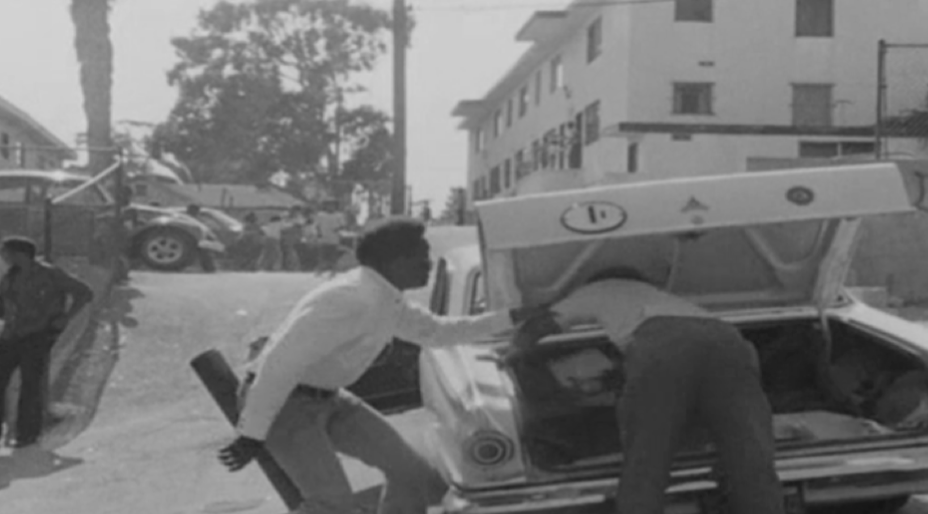
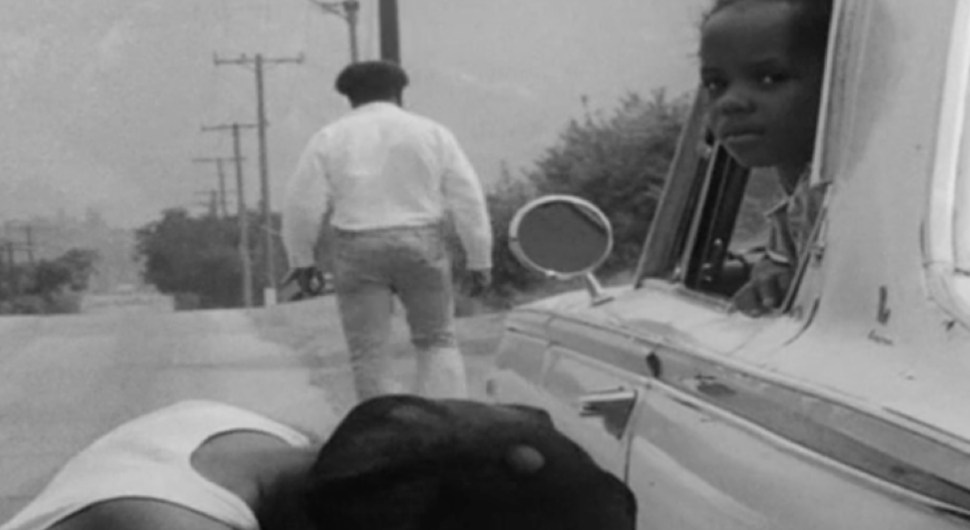

(figures 1-4)
It is interesting to note how in-focus both foreground and background are. In “Intensified Continuity”, David Bordwell has pointed out how, after the seventies, filmmakers used more and more “wide-angle shots with strong foreground/background interplay” (Bordwell 16-28). The almost exaggerated use of shots like these in Burnett’s film suggests a strong connection between the characters portrayed and the space they occupy, namely Watts in the early seventies. However, it also serves the purpose of creating distance between the characters through the help of tactical mise-en-scene and stark chiaroscuro. This distance is particularly accentuated within shots that portray Stan’s wife with men.

Figure 5
In the above picture, for example, the woman is standing against a completely black backdrop, whereas the man is sitting much closer to the camera, his body contours sharply delineated by the colour contrast with a tiled white wall that invokes the pattern of a prison cell. Curiously, the wife’s body and gaze are pointed towards him, but he is facing away.
Already, then, there are two levels in which the woman is visually excluded from the ongoing situation: by being cast to the background, and by having to face the man’s back. Yet, instead of speaking her mind or explaining what she came to do, she just stares at an “off-screen diegetic space” (which, as the montage reveals, is nothing but her husband’s own figure) (Bordwell).
This shot therefore embodies bell hooks’ claim that “Black women had been asked to fade into the background—to allow the spotlight to shine solely on black men.” (hooks) The idea of fading into the background is brought up again later in the film, where a close-up shot of Stan’s wife shows her completely engulfed in the surrounding darkness:
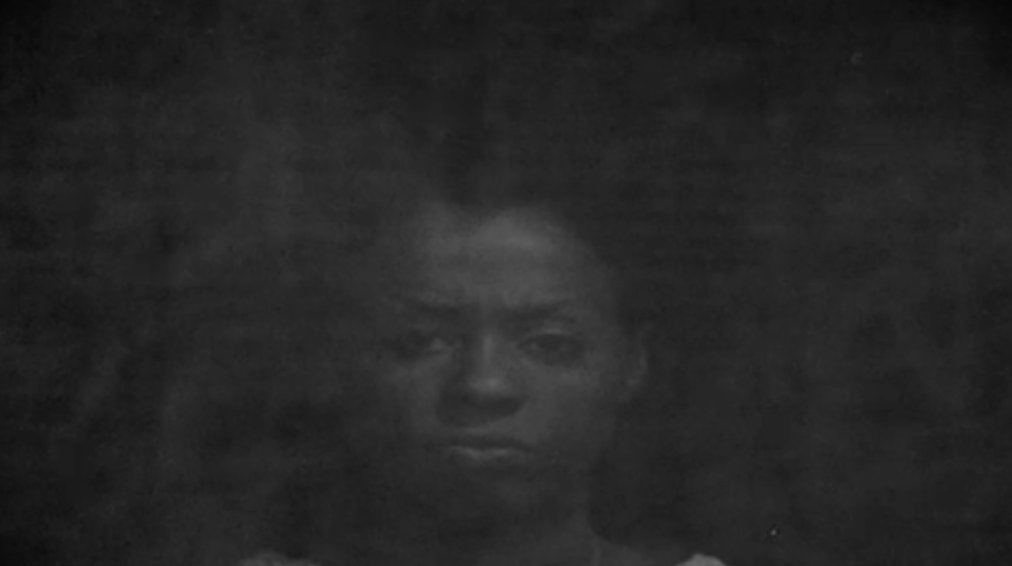
Figure 6
It is significant that, despite this film being mostly resistant to close-ups, Burnett still chose to keep this shot of her face. While, once again, there are no words spoken on her part, her furrowed eyebrows and stern look invite the audience to wonder what she may be thinking about. The fact that the camera lingers on this very moment shows that Burnett is at least somewhat aware of the internal conflict black women were experiencing during those years.
Interestingly, this relegation to the background is also passed down to Angela, Stan’s daughter. This becomes evident in Figure 7, where the composition is nearly the same as in figure 5. Scholar Sean Watkins highlights how, across the film, Angela “watches intently in every scene the elements of blackness that will define her life, cultural expectations of her in a domesticated position relating to males in her life” (Watkins).

Figure 7
Once again, the woman (in this case still in her child stage) is placed in the background, facing the man (also in his child stage) in the foreground. This repetition of female gender roles across generations of black women is reminiscent of Julia Kristeva’s notion of “cyclical time”, which, she argues, is oppositional to historically masculine and linear time (Kristiva
183–207).
In other words, while Stan and his son are portrayed doing different tasks across multiple spaces (or at least are given the opportunity to), both the wife and daughter find themselves in limbo, permanently attached to the domestic enclosure and subjected to a stagnating passivity and silence. The dog mask, in that sense, can be read as a visual metaphor – much like dogs, these women’s main occupation is to “hang around” their owners, without the ability to express themselves.
However, this power dynamic is not as straightforward as it may first appear to be. In fact, in figure 8, it is the wife that occupies the foreground and Stan that occupies the background. Moreover, because she is sitting on a chair and he is working crouched on the ground, her position is technically higher. In this case, however, the shot composition creates a misleading visual hierarchy that can be easily deflated by noting how the woman is, once again, facing the man, whereas the man is facing the other direction. Where Stan is occupied with an “actual” activity, his wife’s role is reduced to the act of watching him.

Figure 8
While the composition of the shot might be misleading in terms of foreground-background division, the distance between the two is only augmented because of the height difference. Two extremely strong diagonal leading lines also divide the frame in four spaces, encapsulating Stan and his wife in their own respective sectors of the image, thus producing a visual sense of alienation that reflects their relationship.
As a matter of fact, this hierarchical complication is precisely one of the core aspects and strengths of Burnett’s filmmaking, which defies labels and enclosures through form as much as it does through content. In her speech about the dangers of the “single story”, Chimamanda Ngozi Adichie reminds her audience how, “The single story creates stereotypes, and the problem with stereotypes is not that they are untrue, but that they are incomplete.” (Adichie) Similarly, Burnett’s characterisation also destabilises our system of beliefs and constantly asks us to reconfigure it to include new variables, because “when we realize that there is never a single story of any place, we regain a kind of paradise.” (Adichie)
Why is her body always orientated towards him? Ahmed notes how “the orientations we have toward others shape the contours of space by affecting relations of proximity and distance between bodies” (Ahmed). Indeed, the wife’s curious way of always facing her husband reflects her readiness to always help and obey him. As hooks has pointed out, Black male activists often “demanded that black women assume a subservient position”(Hooks). Hence, Burnett most likely depicted Stan’s wife with such a bodily orientation because this was the way most black women were socialized to be orientated like in the Watts he knew.
This idea of double oppression – once by race and once by gender – evokes Gayatri Chakravorty Spivak’s notion of the subaltern, whereby, “if, in the contest of colonial production, the subaltern has no history and cannot speak, the subaltern as female is even more deeply in shadow” (Spivak). Of course, the social context that Spivak has in mind as she writes A Critique of Postcolonial Reason is very different from the one of Watts in the seventies. And yet, as written by Robert L. Allen in 1969, “Blacks were the victims of a pervasive cultural imperialism”, adding that “anyone who has lived in a ‘modern’ black ghetto” knows that “the predominantly white police forces which patrol these communities are referred to as a ‘colonial army of occupation’” (Allen). Significantly, Spivak also stresses that “the subaltern as female cannot be heard or read” (Spivak).
In Killer of Sheep, however, it is not like Stan’s wife is literally unable to speak. On the contrary, there are several moments when she is the one that steers the conversation. One of these moments is particularly interesting to look at. In figure 9, she is captured outside with Stan as two stereotypical gangsters, Smoke and Scooter, implore him to join some criminal activity that involves killing. Already, the composition of the shot is very important. While Stan may be the one at the centre of the action, he is sitting on the stairs in a very non-confrontational and passive way. His wife, on the other hand, is towering over the three men despite being relegated to the background. In this moment of apparent power, she screams, “Wait! You wait just one minute. You talking about ‘Be a man, stand up’? Don’t you know there’s more than just fists? The scars, you talking about an animal, you think you’re still in the bush somewhere? You’re here, you use your brain.” Because her aggressive monologue even sends the two gangsters away, one could argue that she is not as unheard or silent as this essay makes her to be.
However, as bell hooks postulates, there is a line between speaking up for an external cause and speaking up for oneself (Hooks). She writes: “While we denounced male concepts of black macho as disgusting and offensive, we did not talk about ourselves, about being black women, about what it means to be the victims of sexist-racist oppression” (Hooks).
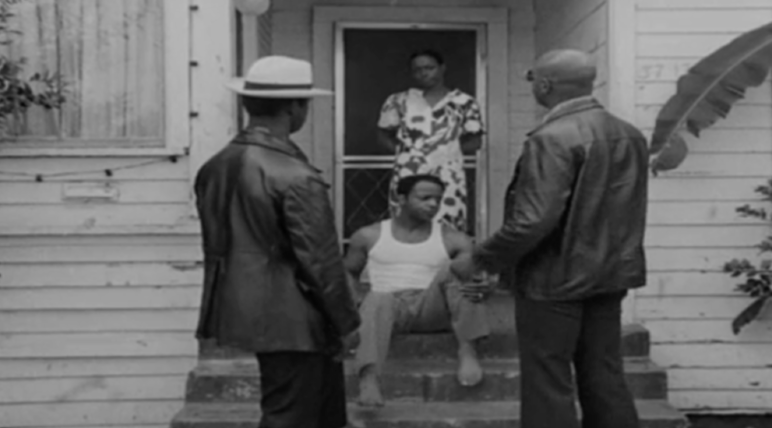

Figures 9-10
A natural follow-up question we may ask is whether Stan’s wife is at fault for her own silent acceptance of her “inferior status”. In her study on black women’s post-slavery silence, Patricia A. Boussard asks: “have Black women been complicit in their own suffering because of their silence?” However, before even attempting to answer it she immediately warns how such a question may “fail to address who created and maintained a system that allowed and perpetuated the sexual abuse of Black women.”
Indeed, Killer of Sheep features several moments where there is a lot of tension and resistance in the image, as if something is being communicated without being said out loud. In figure 5, for instance, Stan’s wife’s body language and stance seem highly confrontational, yet the spectator can only make guesses as to what she is confronting Stan about.

Figure 11
In the shot above (figure 11), she is grappling the window in desperation. Again, despite the lack of speech, we can see her pained state of mind due to her body language. Moreover, the complete darkness of the room, paired with the bright light that penetrates from the big window, makes it seem like she is holding onto it to escape the house and all the burdens and sexist structures that come with it.
Similarly, in the shot sequence with figures 12 and 13, her body language is one of discontent. Looking at the floor, she quietly sighs and shrugs her shoulders; then, as she is cooking, she uses the lid of her pan as a mirror to study her reflection. In other words, by taking an object heavily coded in gender norms and using it to introspectively look at herself, she reconfigures what has been assigned as a domestic tool into a means of self-recognition, momentarily reclaiming her subjectivity within a space designed to suppress it.

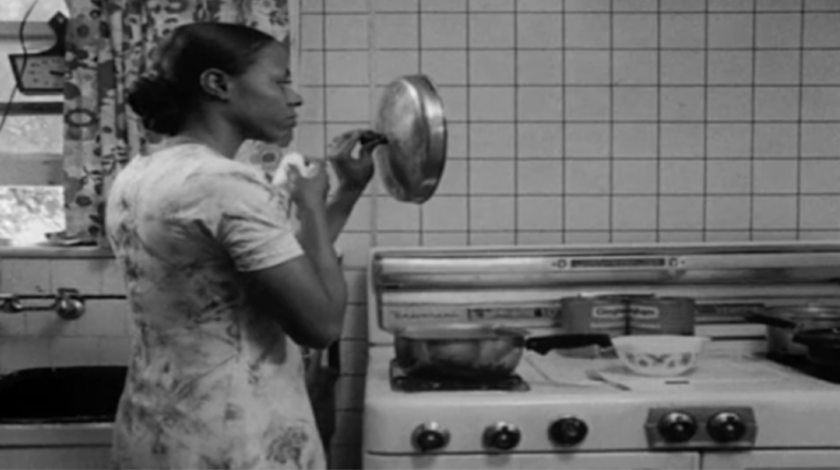
Figures 12-13
Moments like these make us wonder what exactly Burnett aimed to accomplish with this film, and to what extent his sensibility and empathy for black women are consciously felt. Is he portraying black womanhood in a submissive way because he is participating in the structure that makes this possible? Is he portraying the peripherality of black womanhood so as to critique said structure? Or is it one of those in-between, ambiguous combinations of both options that we can’t quite put a name on, but which leave us with a feeling of insatiable hunger and ambivalent emotions? This is a question we shall not answer, for we must not fall for the single story.
Ultimately, what matters is that, in Killer of Sheep, Charles Burnett crafts a radical cinematic language that centres the lived experience of Black communities in post-industrial Watts. Yet, as this essay has shown, the film’s visual and narrative strategies often marginalise its female characters – particularly Stan’s wife – by confining them to a silent and passive domestic sphere.
Through a close reading of shot composition, body language, and spatial orientation, it becomes clear that Black women remain doubly oppressed in both the real and the cinematic world. Hence, just like in real life, the on-screen 1970 Watts wife is subjugated to both structural racism and persistent patriarchal norms.
While the film may not overtly silence its women, their gestures, secret glances, and lingering presences tell a quieter story—one brimming in constraint and yearning. This reading challenges us to reconsider not only how we interpret Black cultural texts, but also who is and who isn’t allowed to speak within them. Following Lorde’s call to “seek out the words of women,” a more inclusive critical gaze must recognize these otherwise often overlooked voices. That is, not as footnotes to male experience, but as central figures in the narrative of liberation.
Bibliography
Adichie, Chimamanda Ngozi. “The danger of a single story.” 20 Jul. 2009, https://youtu.be/D9Ihs241zeg?si=564mhzJ0I9ivBhK4
Ahmed, Sara. Queer Phenomenology: Orientations, Objects, Others. Durham: Duke University Press, 2006. https://doi.org/10.1515/9780822388074.
Allen, Robert L. Black Awakening in Capitalist America: An Analytic History. 3. print. Trenton, N.J: Africa World Press, 1992.
Bordwell, David. ‘Intensified Continuity Visual Style in Contemporary American Film’. Film Quarterly 55, no. 3 (1 March 2002): 16–28. https://doi.org/10.1525/fq.2002.55.3.16.
———. Narration in the Fiction Film. Nachdr. Madison: Univ. of Wisconsin Pr, 2007.
Burnett, Charles, Everette Silas, Henry G. Sanders, Kaycee Moore, Kino Lorber, and Kanopy. Killer of Sheep. San Francisco, California, USA: Kino Lorber, 2021.
Hooks, Bell. Ain’t I a Woman: Black Women and Feminism. Nachdr. Pluto Classics. London: Pluto Press, 2001.
Hughes, Langston. ‘The Negro Artist and the Racial Mountain (1926)’. In Within the Circle, edited by Angelyn Mitchell, 55–59. Duke University Press, 1994.
Jackson, Danielle Amir. ‘Killer of Sheep: Everyday Blues’. The Criterion Collection (blog), 7 May 2025. https://www.criterion.com/current/posts/8817-killer-of-sheep-everydayblues?srsltid=AfmBOootri7ac0bZ36ErRHkYAvzDf4OE3AL5xNsrC_JnNn0aJ8LbiO4
S. Kristeva, Julia. ‘19 Women’s Time (1977)’. In The Princeton Sourcebook in Comparative Literature, edited by David Damrosch, Natalie Melas, and Mbongiseni Buthelezi, 183–207. Princeton University Press, 2009. https://doi.org/10.1515/9781400833702-021.
Mary Maillard. ‘Film Review: Killer of Sheep’. Black Camera 9, no. 1 (2017): 323.
Massood, Paula J. ‘An Aesthetic Appropriate to Conditions: Killer of Sheep, (Neo)Realism, and the Documentary Impulse’. Wide Angle 21, no. 4 (October 1999): 20–41.
Spivak, Gayatri Chakravorty. A Critique of Postcolonial Reason: Toward a History of the Vanishing Present. Cambridge, Mass: Harvard University Press, 1999.
Watkins, Sean Davis. ‘The Turning Point of Who Shall Be Master: Killer of Sheep, Naming, Gender, and the Gaze of African American Women’. Masters Thesis, Kennesaw State University, 2016. https://digitalcommons.kennesaw.edu/mast_etd/4/.
 Spotlight Magazine
Leave a comment